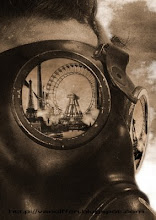
I: a neurological concept that allows an organism to place itself in the context of things it perceives. To determine its place, time, relation to other objects and beings.
Since the 'I' concept is an unevenly compiled synthesis of highly limited current exterior and interior perceptions and of greatly flawed memories of past ones, it can only give a highly skewed image. Nevertheless, through adaptation, this image will be sufficiently perfect for most life situations.
Tuesday, 7 July 2009

ich störung
Menschen mit 'ich-störung': "Reisende unterwegs in unvorstellbare Länder, Länder von denen wir sonst gar nichts wüssten" (Oliver Sacks: 'Der Mann, der seine Frau mit einem Hut verwechselte')
Triopetra
Labyrinth made by German woman with cancer.
Maria in the labyrinth
we in the labyrinth
it is always quicker to get out of it than to enter it.
this place is the origin of an energetic arch.
Ghosts: a newcomer to a place is just sees the place, even though for others it is a scene populated with the ghosts of their memory. See us lying there at night, where others now just contemplate the sea.
The sun rises in Palermo – Maria tries to tell the story, and always gets interrupted. Two murderers, a star?
All the woman are either called Eva, or Marie.
Harris and his contemplative movie of the derwishes, involuntarily close to a Monthy python view on Sufi dances.
Drifter
In all photographies, pictures of the army, even his wedding, Hans looked into some far away point on the left; he almost never faced the camera directly, and only did so when he was particularly at ease. This however appears to be only the case of some pictures with his army Kameraden, shortly before, or at the beginning of the war. Never afterwards.
I guess that's just how he was (not)facing life and always hung out in some remote place, somewhere to the left.
Maybe I am the same.
I guess that's just how he was (not)facing life and always hung out in some remote place, somewhere to the left.
Maybe I am the same.
Subscribe to:
Posts (Atom)